Carlos Scarpero, Senior Loan Originator Specializing in VA Loans

VA Just Changed How Collections Count On A VA Loan

YouTube video player

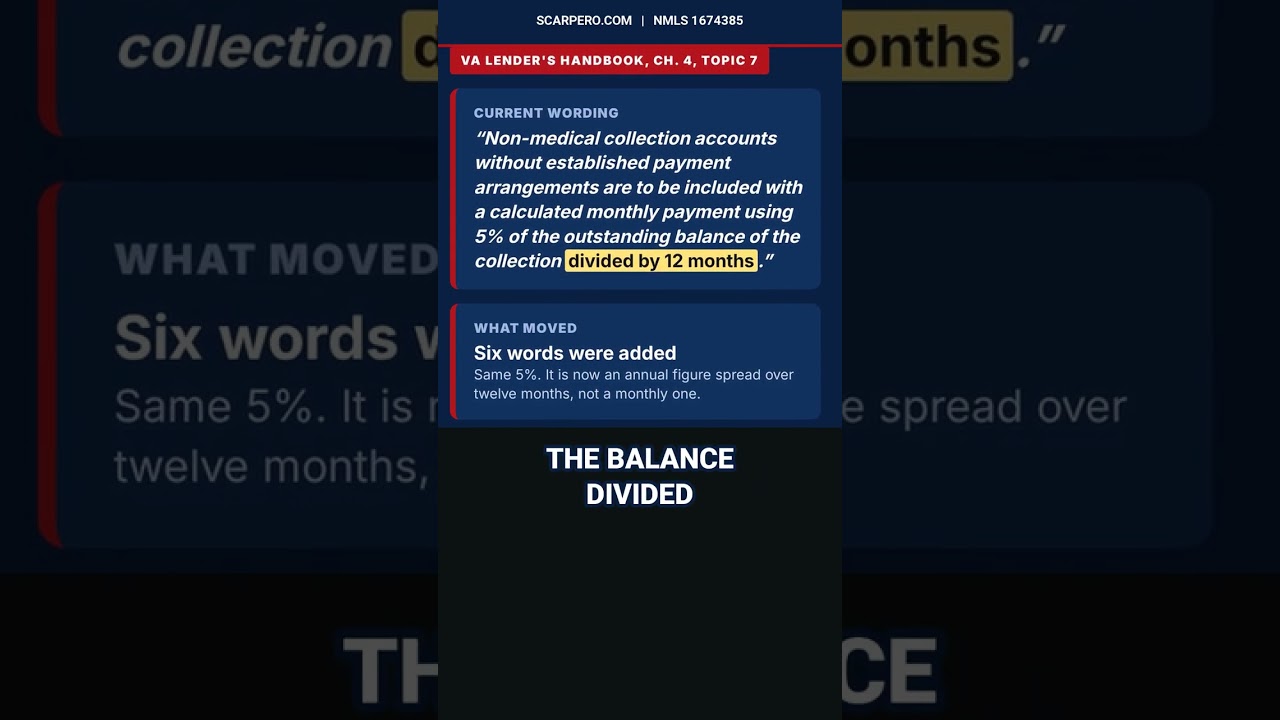
The VA Lender's Handbook now says a non-medical collection account with no payment arrangement is counted at 5 percent of the balance divided by 12 months. Before this wording, most lenders read the same paragraph as 5 percent of the balance per month. On a $10,000 collection with no payment plan, that is the difference between about $500 a month and about $41.67 a month working against your debt to income ratio. The change is in the handbook text itself. VA has not issued a circular about it, so expect some lenders and some automated systems to still be running the old number for a while.

What the VA handbook actually says now

This is a VA rule, quoted from Chapter 4, Topic 7 of VA Pamphlet 26-7, the section that covers credit history documentation and analysis.

VA HANDBOOK EXCERPT

“Non-medical collection accounts without established payment arrangements are to be included with a calculated monthly payment using 5% of the outstanding balance of the collection divided by 12 months. Borrowers with a history of such accounts should have re-established satisfactory credit in order to be considered a satisfactory credit risk.”

Read that slowly. The 5 percent figure did not change. What changed is that the 5 percent is now spread across twelve months instead of being treated as the monthly payment. Five percent of a $10,000 collection is $500. Divided by 12 months, the payment your underwriter uses is about $41.67.

Source:

VA Lender’s Handbook (Pamphlet 26-7) – Chapter 4, Topic 7

How much does this change your numbers?

The table below is an illustration of the guideline math only. It is not a quote, an offer of credit, or a prediction of what any lender will do with your file.

Unpaid non-medical collection, no payment planOld reading: 5% per monthCurrent wording: 5% divided by 12
$2,500$125.00$10.42
$5,000$250.00$20.83
$10,000$500.00$41.67
$20,000$1,000.00$83.33

Why this matters so much on a real file: that payment is not a bill you pay, it is a number the underwriter drops onto VA Form 26-6393 and runs through your debt to income ratio and your residual income. A veteran with two old collections totaling $15,000 used to carry roughly $750 a month of phantom debt into qualifying. That is often the entire difference between a payment that works and a denial. Under the current wording the same file carries about $62.50.


Take the 30 second mortgage quiz to see if you qualify

What did not change

This is the part people are going to get wrong on social media this week. The new math is not a free pass on bad credit. Everything below is still in the same chapter.

A minimum payment on your credit report still wins

The 5 percent calculation only applies when there is no payment arrangement. The handbook is direct about it: "If such accounts are listed on the credit report with a minimum payment, then the debt should be recognized at the minimum payment amount." So if you set up a $50 a month plan with a collection agency and it reports, the underwriter uses $50, not the calculation.

Medical collections are still treated separately

Identifiable medical collections and medical charge-offs that have not been reduced to a judgment or lien can be disregarded entirely. The handbook says lenders "do not need to obtain explanations for medical collections or charge-offs and do not need to otherwise address such accounts." That was already true before this change, and it is one of the most misunderstood parts of VA guidance on open collections.

The underwriter still has to address the account

A smaller calculated payment does not make the collection invisible. The underwriter still has to explain the account on VA Form 26-6393 and justify why the positive factors outweigh the negative credit history. That is why manual underwriting and a clean letter of explanation still matter on these files.

Re-established credit is still the real test

The same paragraph says borrowers with a history of these accounts "should have re-established satisfactory credit in order to be considered a satisfactory credit risk." Chapter 4 describes that as generally 12 months of satisfactory payments after the last derogatory item was satisfied. That is the rule behind what most loan officers describe as needing a clean year, and it did not move.

Lenders can still be stricter than VA

This one is a lender overlay issue, not a VA rule. VA sets the floor. Individual lenders can require collections to be paid, can require a larger reserve, or can set a credit score minimum. VA does not set a program-level minimum credit score; individual lenders may. If you have been told your collections must be paid off before closing, that is your lender's policy talking, not Chapter 4.

What to do if your lender is still using the old number

This wording is new, so pricing engines, internal guides and some automated underwriting setups have not all caught up. Here is the practical path, based on how these conversations usually go on my files.

  1. Ask your loan officer to pull the current text of Chapter 4, Topic 7 of the VA Lender's Handbook and read the non-medical collection paragraph out loud.
  2. Ask which number the underwriter used for each collection on your 26-6393, and whether the credit report shows a minimum payment for that account.
  3. If a payment arrangement exists, make sure it is documented and reporting, because a documented payment usually beats any calculation.
  4. If you were denied recently on debt to income, ask for a re-run rather than assuming the answer is still no. A $10,000 collection dropping from $500 to about $42 is a large swing in your ratios.
  5. Get a second opinion. A denial from one lender is one lender's read of the file, which is exactly the point of a big lender saying no.

Take the 30 second mortgage quiz to see if you qualify

Should you pay off your collections now?

Not automatically, and this is where the new math changes the strategy. When an unpaid collection carried a $500 a month calculated payment, paying it off was often the fastest way to fix a ratio problem. Now that same account may only cost you about $42 a month in qualifying, so cash that would have gone to a collection agency may be worth more to you as reserves or closing costs.

There is also a credit score wrinkle that has not changed. Paying an old collection can reset the account's activity date on some scoring models, which is why paying off collections can hurt you at the worst possible moment. Talk it through before you send money.

Frequently asked questions

Did VA issue a circular about this?

Not that I can find. The change shows up in the handbook text in Chapter 4, Topic 7. There is no collections circular on VA's 2026 circular list as of August 25, 2026. That matters because lenders often wait for a circular before updating internal guidance, so you may hit a file where the old number is still being used.

Does this apply to charge-offs?

The 5 percent calculation language sits in the non-medical collection accounts section. For charge-off accounts, the handbook says the underwriter must address the circumstances behind the negative credit history when reviewing overall credit, and identifiable medical charge-offs can be disregarded.

Does this mean I can get approved with open collections?

It means an unpaid non-medical collection costs you far less in your ratios than it used to. It is not an approval. Every file is different, and credit history, residual income, housing history and lender overlays all still apply.

What about judgments?

Judgments are a different animal. Chapter 4 says balances reduced to judgment must either be paid in full or be subject to a repayment plan with a history of timely payments, generally 12 payments.

How does this affect a manual underwrite?

It helps in the same place it helps everywhere else: the debt to income ratio and residual income lines on VA Form 26-6393. A manual underwrite still needs the compensating factors and the explanation, but the arithmetic starts from a much smaller number.

My credit report shows a payment on the collection. Which number is used?

The minimum payment shown on the credit report. The calculation is only for accounts without established payment arrangements.

The bottom line

Six words got added to a sentence in the VA Lender's Handbook, and for veterans with old unpaid collections it is one of the friendliest guideline changes in years. It does not erase the account, it does not remove the underwriter's job, and it does not override a lender's own policy. What it does is stop a single old collection from eating hundreds of dollars a month of your buying power.

If you were turned down for a VA loan on debt to income in the last year and collections were part of the reason, this is worth a second look. Related reading: how to get a VA home loan with bad credit and VA loan credit score requirements.

Take the 30 second mortgage quiz to see if you qualify


Carlos Scarpero, Mortgage Loan Originator, NMLS #1674385 | Edge Home Finance, LLC, NMLS #891464 | www.nmlsconsumeraccess.org
Edge Home Finance, LLC is a mortgage broker, not a direct lender or creditor. Licensed in 49 states and D.C. Edge Home Finance, LLC does not arrange, solicit, or originate mortgage loans for real property located in the State of New York.
Edge Home Finance, LLC is a private mortgage broker and is not affiliated with, endorsed by, or acting on behalf of or at the direction of the VA, FHA, HUD, or any other government agency.
Equal Housing Opportunity. Educational content only, not a commitment to lend. Any rates, payments, or dollar figures shown are illustrations used to explain how the rules work, not quotes or offers of credit.

Skip to content